
How Much Does It Cost to Furnish a Living Room in the UK? What a Finished Room Really Includes
By Catherine, Co-Founder of The Living House - online interior designers based in the UK, with 35 years of combined design experience
When we ask new customers what budget they have in mind, one of the most common answers is, quite simply, “We don’t know.”
It is not because they have not thought seriously about the room or are not prepared to invest in it. Usually, they have not furnished a room from scratch for many years, so they have no reliable sense of what the larger pieces now cost - or how quickly the quieter, easily forgotten elements such as curtains, lighting, artwork, accessories and delivery begin to add up.
A budget that initially felt generous can disappear surprisingly quickly, while the room itself still feels unfinished. That is why it helps to understand the full cost before you begin shopping, rather than trying to find room for all the missing pieces at the end.
So, how much does it cost to furnish a living room in the UK?
As a broad planning guide, you might allow anything from approximately £3,000 to finish a room around furniture you already own to £30,000 or more for a complete, quality-led scheme. That is an undeniably wide range and, on its own, not especially helpful. The useful part is understanding what sits between those figures: what each level of investment can realistically achieve, which costs are most often overlooked and what a properly finished room really needs to include.
How much does it cost to furnish a living room in the UK?
At current UK prices, we would use the following as broad starting points:
£3,000–£8,000 to finish a room around furniture you already own
£8,000–£18,000 to redesign a room while retaining selected existing pieces
£15,000–£30,000 or more to furnish and finish a living room largely from scratch
These figures are not targets, nor are they fixed packages. A smaller room furnished thoughtfully from the high street may cost less, while a substantial living room requiring several seating areas, made-to-measure window treatments or a bespoke media wall and bookcases could cost considerably more.
They also assume that the room itself is structurally sound. New flooring, electrical work, fitted joinery, fireplace alterations, decorating and professional design fees would normally need to be considered separately.
What these ranges provide is a more realistic starting point than pricing the most obvious furniture and hoping everything else will somehow fit into what remains.
What should a complete living-room budget include?
A finished living room is made up of several layers. Depending on what is already in place, your budget may need to cover:
Main furniture - Seating, storage, media furniture and larger tables
Occasional furniture - Side tables, consoles, footstools and additional seating
Window treatment - Curtains or blinds, poles or tracks, lining and fitting
Lighting - Ceiling lights, wall lights, floor lamps, table lamps and shades
Soft furnishings - A properly sized rug, cushions and throws
Finishing pieces - Artwork, mirrors, decorative objects, plants and books
Practical costs - Delivery, assembly, installation and removal of packaging
Professional work - Decorating, electrical work, joinery and design fees where needed
Not every room will require everything on this list. However, seeing it written down before you begin makes it much easier to decide what matters, what can stay and what might sensibly be purchased later.
It also prevents one of the situations we encounter most often: a customer has invested in several lovely pieces, yet the room still does not feel complete because the lighting, window treatments, rug and finishing details were never considered as part of the original budget.
Need to talk through your home with an expert?
Book your free discovery call here
What did one real Living House living room cost?
When Isobel came to us, her large second-floor living room had barely been used since the family moved into their new home. At 6m by 4.2m, it was a complete blank canvas with an extraordinary view of the sea - and so much potential that knowing where to begin felt overwhelming.
She wanted it to become the room where everyone could sit together on large, comfortable sofas, as well as somewhere that would work beautifully when family and friends came to stay. Making the most of the sea view mattered, too.
There was no existing furniture to work around, although the room already had useful built-in cupboards and shelves in the alcoves beside the fireplace. Isobel’s initial brief included the obvious larger pieces, such as a corner sofa, occasional chairs, side tables and a footstool, but a complete room needed much more. There was the pendant, floor, table and wall lighting; a rug; curtains; cushions and throws; styling for the built-in shelves; window-seat ideas; family photographs; artwork inspired by the sea; and plants that needed to be, in Isobel’s words, “unkillable or faux”.
By the time every part of the design had been considered, the final shopping list contained 48 individual items, ranging from the large corner sofa to a small decorative box. This is exactly why furnishing budgets can be difficult to anticipate: it is not only the cost of the largest pieces, but the number of smaller decisions required to make the room feel complete.
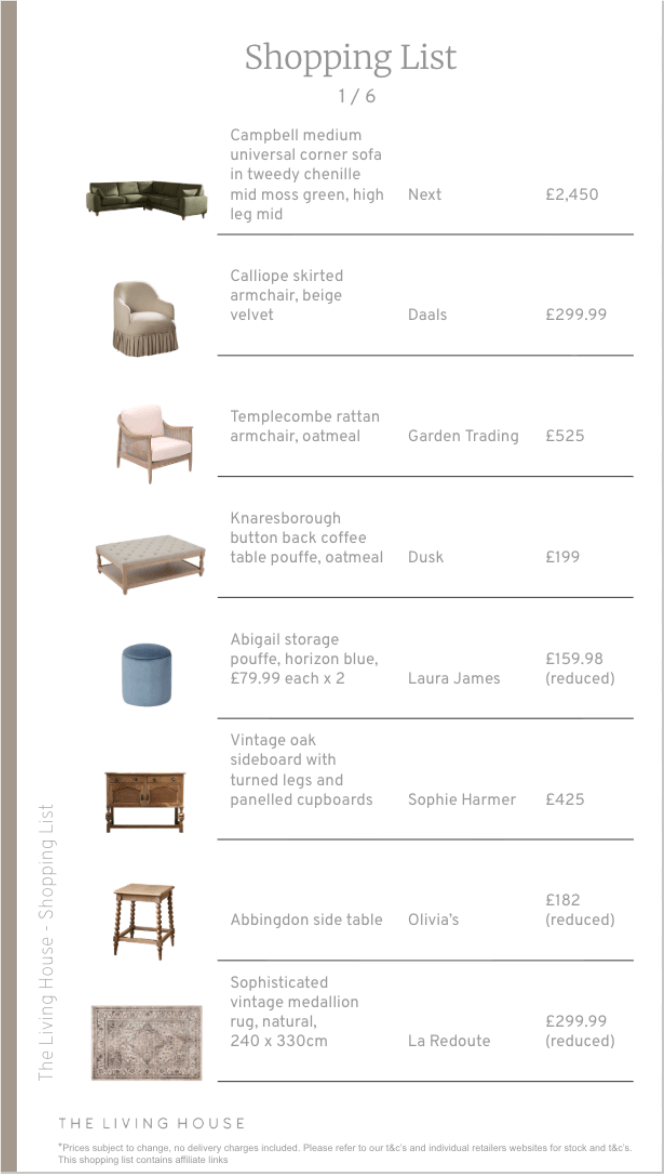
Isobel hoped to keep the product budget below £10,000. The final shopping list came to £9,506, excluding the window-seat cushion, our design fee, delivery charges and any trades required.
Within that product budget, approximately:
£4,800 was allocated to furniture
£510 was allocated to lighting
£1,800 was allocated to finishing pieces, including the rug, cushions, throws, artwork and accessories
£846 on a new electric logburner stove fire, surround and reclaimed hearth tiles
£600 was allocated for paint
£950 was allocated for window treatments
The plan was never to order all 48 items immediately. Isobel intended to purchase them over the following year, taking advantage of sales where possible. Because the complete room had already been designed, she could buy at her own pace without having to rethink the scheme or wonder whether each new piece would work with everything else.
After receiving the design, she told us:
“We absolutely love the design - thank you. It’s everything we hoped for! We watched the video straight away and found it really helpful, and are more than stuck into our shopping list already.”
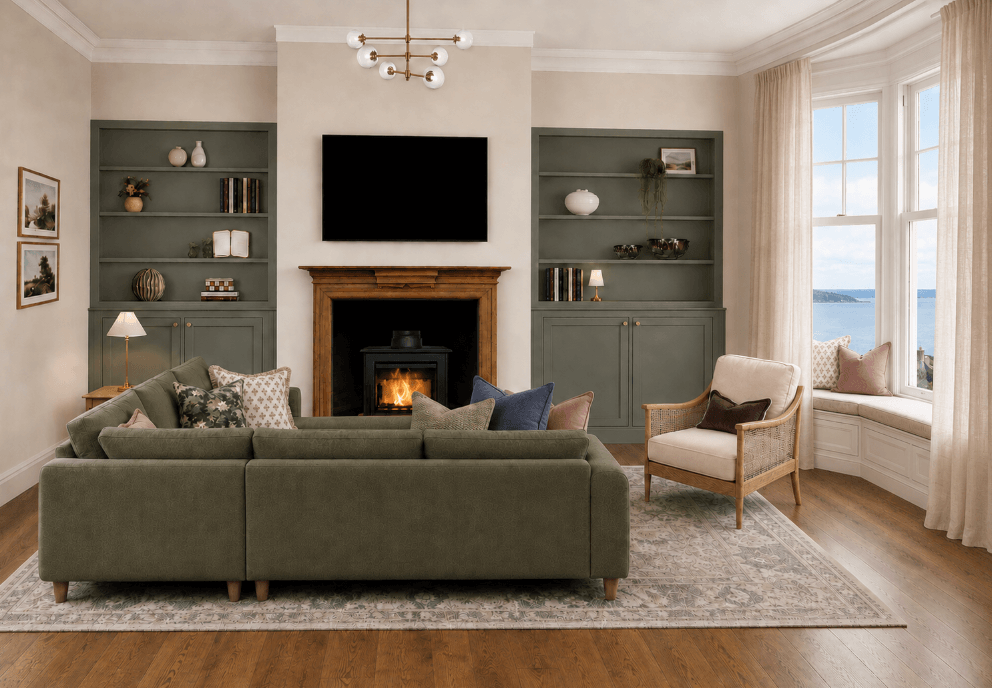
This example does not mean every empty living room can be furnished for £9,506. Isobel’s total was the product shopping list rather than the complete project cost, and several important elements sat outside it. What it does show is how a clear plan can turn an overwhelming blank canvas into 48 manageable, coordinated decisions - and make it possible to complete the room gradually without losing sight of the finished result.
Finishing a living room around furniture you already own: £3,000–£8,000
Sometimes the main furniture is perfectly good, but the room has never quite progressed beyond it.
There may be a large window with temporary blinds, a ceiling light inherited from the previous owner or a rug that looked generous online but feels lost once it is in the room. The furniture is there, yet the space still feels more functional than inviting.
In this situation, the budget is not necessarily being used to replace anything substantial. It is being used to create the relationships that are currently missing.
Window treatments soften the architecture and help with scale. A larger rug connects the seating rather than floating between it. Several sources of light make the room feel comfortable in the evening. Artwork, tables and carefully chosen finishing pieces give it personality and balance.
Take a look at our rug buying guide.
In our experience, these elements are often treated as optional extras. We see them differently: they are frequently the difference between a room that contains some lovely furniture and a room that feels beautifully put together.
This type of project can make an enormous difference because the money is being spent precisely where the gaps are. The difficulty is identifying those gaps before buying more decorative objects that do not solve the underlying problem.
Redesigning while keeping selected pieces: £8,000–£18,000
Many living-room projects sit within this middle category.
You may have one or two pieces you genuinely love and want to keep, alongside other furniture that was bought for a previous home or chosen quickly when you first moved in. The room might work reasonably well, but it does not feel as considered or comfortable as you would like.
Keeping existing furniture can be a very sensible decision, although it requires more thought than beginning with an empty room. Its dimensions, colour, material and visual weight all influence what can sit alongside it.
Before replacing anything, we would establish:
Which existing pieces genuinely deserve a place in the new room
Whether the layout is making the best use of the space
Which new purchases will have the greatest effect
How the old and new elements will connect visually
Whether the finished scheme will meet the practical needs of the family
We do not believe every item in a room needs to come from the same shop or the same price bracket. In fact, a room often feels more personal when it does not. What matters is that the pieces have been chosen with the same overall plan in mind.
Without that plan, it is easy to keep buying individual pieces that are lovely in isolation but do not move the room towards a finished result.
Furnishing a living room from scratch: £15,000–£30,000+
An empty living room can appear to offer complete freedom. In reality, the number of decisions can quickly become overwhelming.
There is the layout to resolve before dimensions can be confirmed. The room may need to accommodate family evenings, entertaining, reading, children or teenagers, pets and perhaps occasional working from home. It needs enough storage, comfortable seating and sensible circulation, but it should not feel as though every available wall and corner has been filled.
We always begin with the life that needs to happen in the room. Only then can we design the room around it.
Once the layout is established, individual pieces can be considered as part of one scheme rather than as a series of unrelated purchases.
For a quality-led family living room, £15,000–£30,000 is a reasonable broad planning range when most of the furniture, lighting, window treatments, rug and finishing pieces are required. Larger rooms, bespoke elements and higher-end materials can take the total beyond this.
That does not mean every item needs to be expensive. We would always rather combine considered investment pieces with well-chosen, less costly finds than spend heavily everywhere for the sake of it. The skill lies in knowing where quality will make a meaningful difference and where a more modest option will work just as well.
Take a look at our sofa buying guide.
Why does furnishing a living room often cost more than expected?
The problem is rarely one wildly expensive decision. More often, it is the accumulation of elements that were not included at the beginning.
Window treatments are left until later
Curtains and blinds can represent a significant part of the budget, particularly in a substantial room with wide or unusually shaped windows. They are also among the elements that most influence how complete a room feels.
Leaving them until the end may mean there is not enough budget remaining to achieve the fullness, length or finish the room needs.
Lighting is treated as a single purchase
A central ceiling light may illuminate a room, but it rarely creates a comfortable atmosphere by itself.
Most living rooms benefit from lighting at different heights: perhaps a floor lamp beside a chair, table lamps near the seating and wall or picture lights where appropriate. Each individual purchase may be relatively modest, but the combined cost needs to be allowed for.
The smaller pieces are not counted
Side tables, lampshades, cushion inserts, curtain poles, artwork and delivery charges can seem too minor to include during the early planning stage. Yet these are often the things still missing months later because the original budget has been spent.
Purchases are made before the whole room is planned
One purchase changes the options available for the next. Dimensions, colours, finishes and proportions are all connected.
When those decisions are made separately over a long period, the room can gradually become an expensive collection of compromises. A clear plan does not necessarily mean spending less, but it does make it much easier to spend with purpose.
Where is it worth investing more?
The answer will be different for every family because it depends on how the room is used.
A household that gathers in the living room every evening may prioritise comfortable, durable upholstery. A room with a beautiful outlook may benefit from properly considered window treatments. A darker room might require a greater proportion of the budget to be directed towards lighting.
As a general rule, we would invest in the pieces that:
Are used heavily every day
Establish the scale or layout of the room
Would be disruptive or costly to replace
Need to withstand children, teenagers or pets
Have a significant effect on comfort
This does not require choosing the most expensive version of everything. It means being clear about which decisions matter most in your particular room.
There are often excellent side tables, lamps and decorative pieces available at relatively modest prices. Mixing these with carefully chosen investment pieces can create a room that feels considered without every item competing for attention.
Can you furnish a living room in stages?
Yes, and for many of our customers this is the most practical approach.
The important distinction is between purchasing in stages and designing in stages.
You do not need to purchase everything at once. You may decide to buy the essential furniture first, add window treatments a little later and leave artwork until you find something you genuinely love.
However, it is helpful to make those decisions within a complete plan. If you already know the intended layout, overall palette, dimensions and priorities, you can purchase at a comfortable pace without repeatedly reconsidering the room.
This was one of the things Isobel particularly valued about her click-to-buy shopping list: once every element had been selected as part of one design, the practical next steps were clear.
A plan gives you somewhere to return when a sale appears, a delivery is delayed or you become distracted by something beautiful that was never part of the original idea.
How should you set a realistic living-room budget?
Before looking at individual products, work through the following questions.
1. What are you keeping?
Be honest about whether each piece is staying because you love it and it works, or simply because replacing it feels like another decision.
2. What does the room need to do?
Start with the people who use the room and what needs to happen there. Then design the room around that life.
3. What does “finished” mean for this room?
List every layer, including lighting, windows, artwork, delivery and fitting. You may choose not to purchase it all immediately, but it should still form part of the plan.
4. Where are your priorities?
Decide which elements matter most to your comfort, the room’s function and the way you want it to feel. This will tell you where to invest and where you can comfortably spend less.
5. Have you allowed some flexibility?
Prices change, delivery costs vary and occasionally the right solution costs more than expected. Keeping approximately 10–15% of the furnishing budget unallocated will give you room to make considered decisions without having to compromise elsewhere.
Does a living-room furnishing budget include interior-design fees?
Usually not. Furniture, furnishings, trades and professional design are normally treated as separate parts of the overall project budget.
At The Living House, our Complete Design service is calculated according to room size. For example, the design fee for a 4m x 5m room is £2,400 including VAT.
This includes two dedicated interior designers, a carefully considered layout, the complete room scheme, visualisation, a detailed design dossier, a curated shopping list and support as you begin putting the room together.
The Power Hour is designed for people who already have much of the room worked out but need expert help with a smaller number of specific decisions.
Take a look at our blog - Is Hiring an Interior Designer Worth It? What You're Really Paying For
A realistic budget should make the process feel easier
Talking about budgets can make designing a room sound rather clinical, when the reason for doing it is anything but.
You want the room to feel comfortable when everyone is home. You want to invite people in without mentally noticing all the things you still have not resolved. You want it to reflect your taste while standing up to the realities of everyday family life.
One of our customers, Nina, described an unexpected change once her living room had been designed. As well as saying that the family loved the room, she told us that she felt more confident because her home reflected who they were and how they operated in the world.
That is the part a spreadsheet cannot show. A realistic budget is not simply a list of costs; it gives you the clarity to make confident decisions, knowing what the room needs, where your money is going and how every piece contributes to the finished result.
And that is ultimately the difference between buying furniture and designing a room.
Need help planning your living room?
If you know the room needs attention but do not have the time or headspace to research every piece, compare hundreds of options and work out how everything will fit together, we can help.
Our Power Hour is ideal when you need focused expert advice to move forward with confidence.
Our Complete Design is for you if you would like the whole room - layout, furniture, colour, lighting, window treatments and finishing details - thought through as one cohesive plan.
Book a free Discovery Call and tell us about your room, what you would like to change and what has been holding you back.
Frequently asked questions
What is the average cost of furnishing a living room in the UK?
There is no single useful average because room sizes, requirements and furniture quality vary considerably. As a broad guide, allow £3,000–£8,000 to finish a room around existing furniture, £8,000–£18,000 for a more substantial redesign retaining selected pieces, and £15,000–£30,000 or more when furnishing a quality-led living room largely from scratch.
Can I furnish a living room for £5,000?
Yes, particularly if you already own some of the main furniture or are willing to purchase the room in stages. A clear plan will help you prioritise the elements that make the greatest difference and prevent the available budget being absorbed by disconnected purchases.
What should be included in a living-room furnishing budget?
Include the main and occasional furniture, rug, lighting, curtains or blinds, storage, artwork, mirrors, accessories, delivery and fitting. Decorating, electrical work, new flooring, bespoke joinery and professional design fees may need to be budgeted separately.
Should I buy everything for my living room at once?
No. You can buy the room in stages, but it is best to create the complete plan first. This allows you to spread purchases over time while keeping the layout, colours, dimensions and overall design consistent.
How much contingency should I allow?
Keeping around 10–15% of your furnishing budget unallocated gives you flexibility for delivery costs, price changes and pieces that cost slightly more than expected.
Is an interior designer included in the cost of furnishing a living room?
Design fees are normally separate from the cost of furniture and furnishings. Some designers charge hourly rates, fixed project fees or a percentage of the overall spend. At The Living House, the Complete Design fee for a 4m x 5m room is £2,400 including VAT.
The Living House is an online interior design studio helping families transform their homes into spaces that are beautiful, functional, and unmistakably theirs. Browse our services atthelivinghouse.co.uk.
RELATED BLOGS:



Here at The Living House, we’re so excited to announce the launch of our new service — The Layout Fix. Designed to help solve your room layout challenges!
As interior designers, we know that getting the layout right is one of the most important parts of a successful design. In fact, it’s always where we start because how can you know what’s going to fit, or how a room will function, if the layout hasn’t been nailed down first?